





 Volume: 36, Issue: 9, September 2026
 Binbin Ma, Shixiong Liang, et al.
Terahertz Chip Interconnects Based on Beam-Lead Structures
Abstract
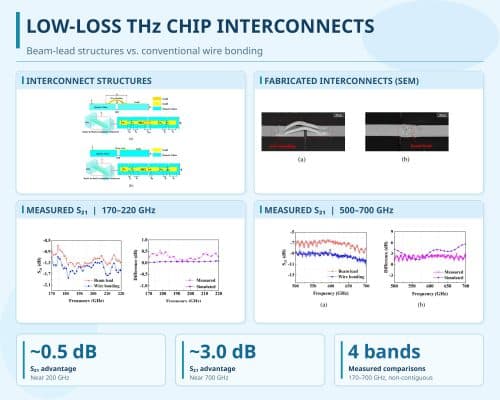
This work suggests using low-loss beam-lead technology instead of wire bonding to prevent performance degradation in THz chip interconnects. Full 3-D finite-element method (FEM) simulations and lumped-element analysis indicate the parasitic reduction process, proving this structure’s superiority. Comparative measurements were taken in four frequency bands: 170–220 GHz, 240–320 GHz, 420–470 GHz, and 500–700 GHz. Experimental results show that the beam-lead interconnection substantially reduces insertion loss by approximately 0.5 dB in the 170–320 GHz range. More crucially, the performance advantage increases as the frequency rises to higher THz frequencies. In the 500–700 GHz range, beam-lead technology outperforms wire bonding by about 3 dB due to reduced inductive degradation. This study shows that beam-lead technology can connect future terahertz (THz) integrated systems with high-performance and wideband connections.
https://ieeexplore.ieee.org/document/11493929 DOI: 10.1109/LMWT.2026.3682397