





 Volume: 74, Issue: 10, October 2026
 Seyed Hossein Hosseini Biuki
Realization of Time-Varying Permeability in Ferrite-Based Microstrip Lines Enabling Sideband Generation: Modeling and Experimental Verification
Abstract
DOI: 10.1109/TMTT.2026.3722725
IEEEXplore: https://ieeexplore.ieee.org/document/11659145
Device
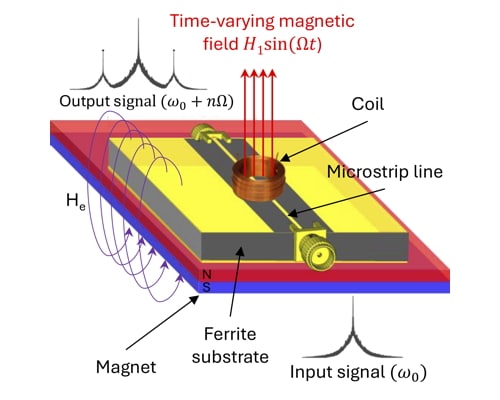
Implementation of time-varying magnetic permeability in a microstrip transmission line fabricated on a grounded ferrite substrate.
Spectrum
5.720 GHz
Novelty
An analytic model was developed for a time-varying microstrip transmission line (TVTL) that derived per-unit-length inductance within a quasi-static framework that accounted for fringing field effects and magnetic memory effects. Validation of the model proved substantially more accurate than the classical Hines model to predict the intrinsic bandgap edges of the structure. The analysis was extended to the time-varying case with the addition of a weak time-modulated magnetic bias field.
The generation of sideband harmonics and a strong enhancement of harmonic conversion efficiency near the band gap boundaries was experimentally realized when the fabricated ferrite substrate was subjected to a weak, time-modulated magnetic bias field in addition to the substantially stronger saturating static bias field. The modulation field was about 330 times weaker than the static bias field. Experimental measurements validated the model’s accuracy.
Application
Time-varying ferrite-based microstrip lines for broadband harmonic generation and frequency conversion applications.
Performance
-25.7 dBc maximum first-order normalized harmonic conversion efficiency.