





 Volume: 36, Issue: 5, May 2026
 Maurício Duarte Almeida
Development of a Magnetic Resonant Wireless Power Transfer System for Brain Implants
Abstract
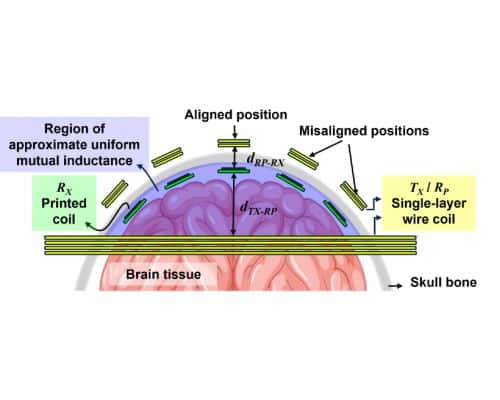
This letter presents the design and experimental evaluation of a magnetic-resonant wireless power transfer (WPT) system for brain implants. A circuit-based model is proposed to predict the behavior of multicoil structures and to accurately estimate self- and mutual inductances under lateral and angular misalignment. A method is introduced to identify the spatial regions of approximately uniform mutual inductance, improving robustness relative to conventional repeater-assisted configurations. The influence of biological media is evaluated using an equivalent homogeneous head model representing the averaged dielectric properties of the underlying tissues. The proposed system was evaluated through the proposed modeling, full-wave CST simulations, and experimental measurements in air and in the equivalent biological medium. Results show close agreement among all approaches and confirm that tissue heterogeneity has negligible impact on coupling, resonance, and delivered power. The system operates stably across different implant positions, delivering the required power for neural devices implants.
DOI: 10.1109/LMWT.2026.3655285 IEEEXplore:https://ieeexplore.ieee.org/document/11371354