




-
Tuesday, July 28, 2026 12:00 pm - 1:00 pm(New York Time) Add to my calendar
-
Date
 Tuesday, Jul 28, 2026
 -
Contact
 Contact Sponsor
 -
Registration
 Register here

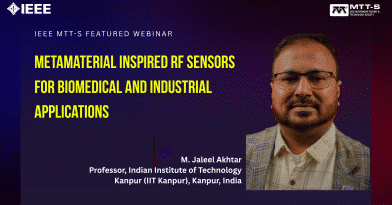
Metamaterial Inspired RF Sensors for Biomedical and Industrial Applications
Abstract:
The planar technology is presently widely being used for developing various types of modern RF devices and components including RF sensors. The field of RF planar sensors usually involves design and development of a compact planar structure for determining the electrical signatures of materials and media in the RF and microwave frequency range using their electromagnetic (EM) properties. In recent years, the usage of RF planar sensors based on meta elements such as the split ring resonator (SRR), and the complementary split ring resonator (CSRR) has increased due to their improved sensitivity, which is particularly beneficial for biomedical and industrial sectors. High sensitivity RF sensors provide a substantial advantage by enabling the early detection of diseases and the identification of minute levels of adulteration for biomedical and industrial applications.
This talk would provide a brief overview of metamaterial inspired planar RF sensors with prime focus on industrial and biomedical applications. Several applications of these special types of RF sensors such as testing the purity of any edible or bio-grade fluid, estimation of glucose concentration in blood, detection of food adulteration and oil spill, identification of skin burn and subsurface imaging for defect and crack detection etc., would be discussed.
Speaker’s Details:
M. Jaleel Akhtar
Professor, Indian Institute of Technology Kanpur (IIT Kanpur), Kanpur, India
M. Jaleel Akhtar received the Ph.D. degree in Electrical Engineering from the Otto-von-Guericke University of Magdeburg, Magdeburg, Germany, in 2003. He was a Scientist with the Central Electronics Engineering Research Institute, Pilani, India, from 1994 to 1997, where he was involved in the design and development of high-power microwave devices. From 2003 to 2009, he was a Post-Doctoral Research Scientist and a Project Leader with the Karlsruhe Institute of Technology (KIT-FZK), Karlsruhe, Germany, where he primarily worked in the areas of industrial microwave technology. In 2009, he joined the Department of Electrical Engineering, Indian Institute of Technology Kanpur (IIT Kanpur), Kanpur, India, where he is currently a Senior Professor.
He has supervised more than 30 Ph.D. candidates and over 90 masters’ students for their theses. He has been the lead investigator of more than 15 projects in various domains of RF and microwave technology, including a major project involving establishment of a world class fully accredited EMI/EMC Test Facility at IIT Kanpur, India. Dr. Akhtar has authored two books and four book chapters. He has authored or co-authored over 180 papers in various peer-reviewed international journals and over 250 papers in international conference proceedings. He holds three patents on planar RF sensors for various applications. His current research interests include metamaterial inspired RF sensors, microwave, mm-wave and THz imaging, FSS and metasurface based EMI shielding structures, RF energy harvesting, wireless power transfer and nanocomposites-based wideband microwave absorbers for stealth technology and EMI/EMC applications.
Dr. Akhtar is the Fellow of IEEE, Fellow of the Indian National Academy of Engineering, and a Fellow of IETE. He is a recipient of the Excellence-in-Teaching Award (ETA) 2021 from IIT Kanpur, and the CST University Publication Award in 2009 from the CST AG, Darmstadt, Germany. He was elected Administrative Committee (AdCom) member of the IEEE Microwave Theory and Technology Society (MTT-S) during 2023-25, and 2025 MTT-S Education Committee Chair. He was the General Co-Chair of IEEE MAPCON-2023, and the MTT-S International Microwave and RF Conference (IMaRC 2021). He served as an Associate Editor of the IEEE Sensors Journal during 2020-2023. He is currently serving as an Associate Editor of the IEEE Transactions on Microwave Theory and Techniques, Editor of the IETE Technical Review, the IETE Journal of Research, and SADHANA – Academy Proceedings in Engineering Journal.