




 Volume: 74, Issue: 3, March 2026
 Yinjun Liu
Demonstration of Transparent Polarization-Division Multiplexed Fiber–Radio–Fiber Bridge at W-Band Based on Direct Full-Photonic Conversions
Abstract
DOI: 10.1109/TMTT.2025.3644700
IEEEXplore: https://ieeexplore.ieee.org/document/11314774
Device
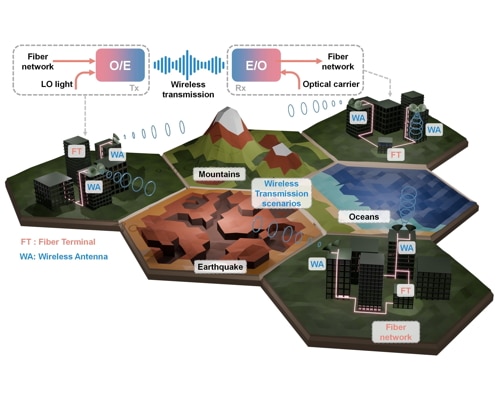
Transparent polarization-division multiplexed fiber–radio–fiber signaling bridge with direct full-photonic conversions.
Spectrum
75 – 110 GHz (W-band)
Novelty
The full photonic conversion fiber-radio-fiber bridge employs numerous optimizations including center frequency optimization given the components in the architecture, the optical signal power and LO power ratio at the transmit end, the input optical power (IOP) before the photodiode at the transmit end to optimize modulation depth of the Thin-Film Lithium Niobate Mach–Zehnder Modulator (TFLN-MZM) and noise performance of the LNA at the receive end, and the bias voltage of the TFLN-MZM at the receive end.
Application
Seamless integration of ultrahigh-speed wireless communication systems with optical fiber networks to support high data rate 6G applications.
Performance
140 Gbit/s single channel maximum data rate using 35-Gbaud/s 16-quadrature amplitude modulation (16QAM) and 155 Gbit/s using 31-Gbaud/s 32QAM over a 20-km transmission fiber, a 1-m wireless link, and a 10-km reception fiber. These are the highest known rates for single-channel direct full-photonic fiber–radio–fiber links
264 Gbit/s (33 Gbaud/s × two polarizations ×4 bits/symbol) by employing optical polarization-division multiplexing and a 2 × 2 multiple input multiple output (MIMO) antenna array, a record total line rate.