




-
Tuesday, May 12, 2026 12:00 pm - 1:00 pm(New York Time) Add to my calendar
-
Date
 Tuesday, May 12, 2026
 -
Contact
 Contact Sponsor
 -
Registration
 Register here

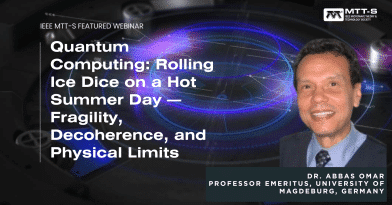
Quantum Computing: Rolling Ice Dice on a Hot Summer Day — Fragility, Decoherence, and Physical Limits
Abstract:
The inherently fragile nature of quantum coherence in qubits is examined through an illustrative analogy: the rolling of ice dice on a hot summer day. For the dice to retain their well-defined faces and edges, the rolling process must be completed before melting leads to deformation and loss of distinguishability. This analogy captures the central challenge of quantum computing: maintaining coherence long enough to perform a complete computational task.
Qubits, the fundamental building blocks of quantum computers, are extremely sensitive to interactions with their environment. Their coherence is characterized by three key time constants, analogous to those used in magnetic resonance imaging (MRI): T1, T2, and T2*. The relaxation time T1 describes energy dissipation processes that drive the system toward thermal equilibrium, while T2 and T2* characterize the loss of phase coherence due to irreversible interactions and environmental fluctuations.
Within this framework, decoherence can be interpreted as a gradual loss of structural integrity in the quantum state, analogous to the melting of ice that blurs the sharp features of a die. As coherence diminishes, the ability to reliably distinguish between quantum states—and hence to perform meaningful computation—is progressively degraded.
This perspective emphasizes a fundamental constraint: a quantum computation must be completed within the coherence lifetime of the system. While techniques such as quantum error correction aim to mitigate these effects, they introduce significant overhead and complexity. The balance between coherence preservation, control precision, and system scalability, therefore, represents a central challenge in assessing the practical feasibility of large-scale quantum computing
Speaker’s Details:
Dr. Abbas Omar
Professor emeritus, University of Magdeburg, Germany
Dr. Omar is a Professor Emeritus at the Otto von Guericke University of Magdeburg in Germany. He received his B.Sc., M.Sc., and Doktor-Ing. degrees in electrical engineering in 1978, 1982, and 1986, respectively. He has been a professor of electrical engineering since 1990 and served as the Director of the Chair of Microwave and Communication Engineering at the Otto von Guericke University of Magdeburg, Germany, from 1998 until his retirement in 2020.
He joined the Petroleum Institute in Abu Dhabi as a Distinguished Professor in 2012 and 2013, where he organized research activities for the oil and gas industry in the region. In 2014 and 2015, he chaired the Department of Electrical and Computer Engineering at the University of Akron, Ohio, USA.
Dr. Omar has authored and co-authored more than 490 technical papers spanning a wide spectrum of research areas. His current research and teaching interests include quantum computing, the health aspects of millimeter-wave radiation, phased arrays and beamforming for massive MIMO, and magnetic resonance imaging.
In the past, he has also contributed to various other disciplines, including microwave and acoustic imaging, microwave and millimeter-wave material characterization, indoor positioning, subsurface tomography and ground-penetrating radar, as well as field-theoretical modeling of microwave systems and components.
Dr. Omar is a Life Fellow of the IEEE.