



-
Tuesday, April 14, 2026 12:00 pm - 1:00 pm(New York Time) Add to my calendar
-
Date
 Tuesday, Apr 14, 2026
 -
Contact
 Contact Sponsor
 -
Registration
 Register here

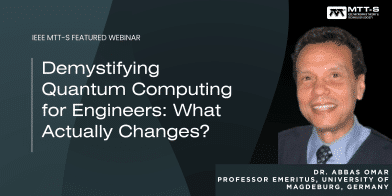
Demystifying Quantum Computing for Engineers: What Actually Changes?
Abstract:
A generalized conceptual model that uses a unified state space for both classical computers (CC) and quantum computers (QC) is presented to enable a fair and transparent comparison between the two paradigms. The QC should not be viewed as a replacement for the CC; rather, the two technologies complement each other. Depending on the nature of the problem, either a CC or a QC may offer superior efficiency. While classical computers excel at deterministic processing and produce exact outputs, quantum computers excel at coherently shaping outcome probability distributions and produce stochastic samples upon measurement.
The problem of determining the period of a periodic function is analyzed as a representative example, without assuming prior knowledge of quantum mechanics. This problem is central to tasks such as integer factorization. It will be solved once using a classical approach and once using a quantum approach, highlighting the fundamental differences in resource requirements. The well-known Shor algorithm will be explained as an illustrative example of a class of problems that can be solved significantly more efficiently using quantum computers.
Speaker’s Details:
Dr. Abbas Omar
Professor emeritus, University of Magdeburg, Germany
Dr. Omar is a Professor Emeritus at the Otto von Guericke University of Magdeburg in Germany. He received his B.Sc., M.Sc., and Doktor-Ing. degrees in electrical engineering in 1978, 1982, and 1986, respectively. He has been a professor of electrical engineering since 1990 and served as the Director of the Chair of Microwave and Communication Engineering at the Otto von Guericke University of Magdeburg, Germany, from 1998 until his retirement in 2020.
He joined the Petroleum Institute in Abu Dhabi as a Distinguished Professor in 2012 and 2013, where he organized research activities for the oil and gas industry in the region. In 2014 and 2015, he chaired the Department of Electrical and Computer Engineering at the University of Akron, Ohio, USA.
Dr. Omar has authored and co-authored more than 490 technical papers spanning a wide spectrum of research areas. His current research and teaching interests include quantum computing, the health aspects of millimeter-wave radiation, phased arrays and beamforming for massive MIMO, and magnetic resonance imaging.
In the past, he has also contributed to various other disciplines, including microwave and acoustic imaging, microwave and millimeter-wave material characterization, indoor positioning, subsurface tomography and ground-penetrating radar, as well as field-theoretical modeling of microwave systems and components.
Dr. Omar is a Life Fellow of the IEEE.